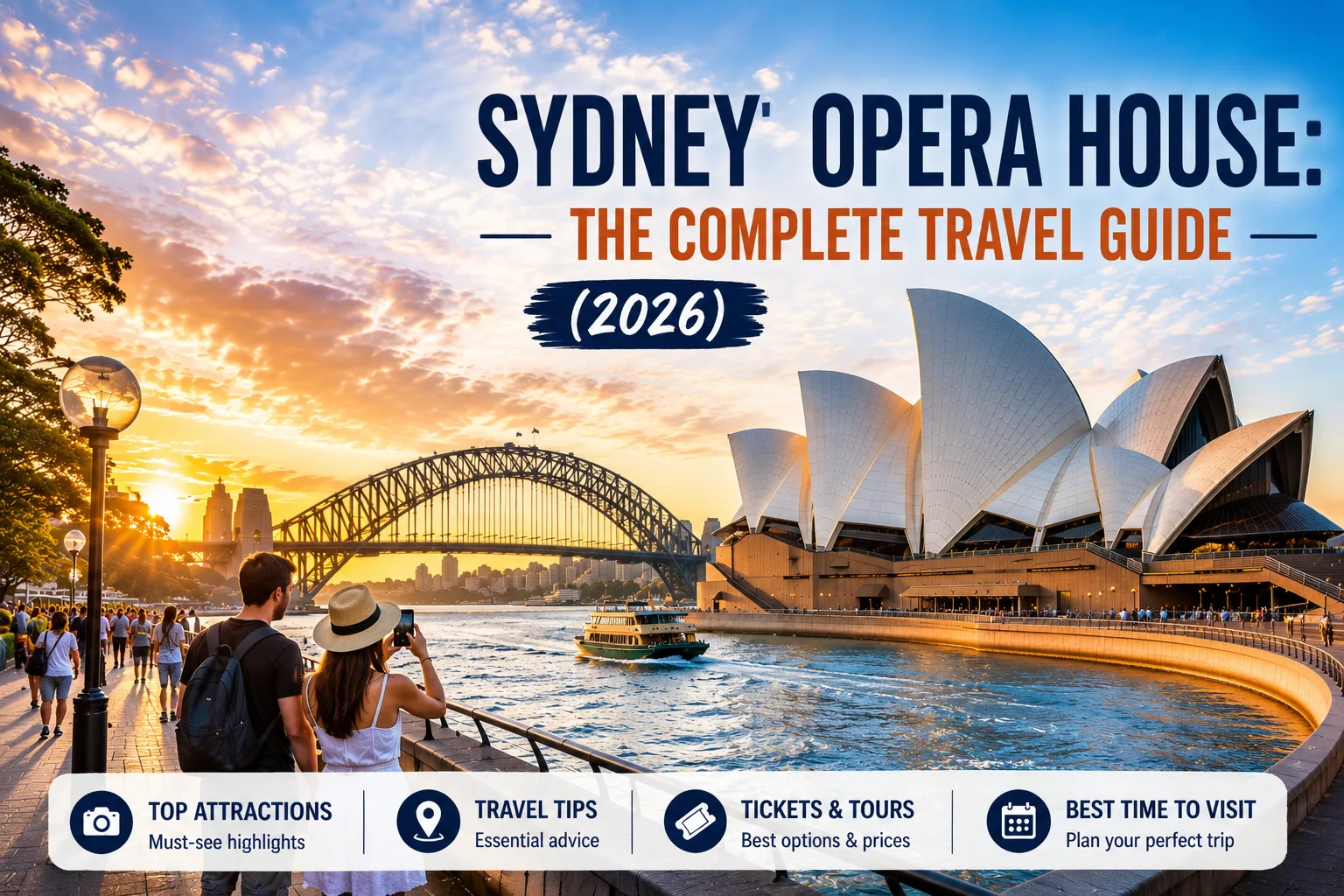
Sydney Opera House: The Best Complete Travel Guide (2026)
If you’ve ever flipped through a travel magazine or scrolled past a “world’s most beautiful buildings” list, chances are you’ve seen it: those gleaming white shells rising out of Sydney Harbour like sails caught mid-billow. That’s the Sydney Opera House, and no photo really prepares you for standing in front of it in person.
I want to walk you through everything worth knowing before you go — the history behind it, how to actually experience it (not just photograph it from across the water), and a few things I wish someone had told me before my own first visit or Sydney Opera House.
A Brief History of the Sydney Opera House
The idea for the Opera House goes back further than most people realize. In the 1940s, a conductor named Eugene Goossens kept pushing Sydney’s government to build a proper venue for opera and orchestral performances. At the time, there really wasn’t anywhere in the city equipped to host something on that scale.
Nothing moved quickly, though — it wasn’t until 1956 that an international design competition finally opened up. Over 230 architects from more than 30 countries threw their hat in the ring. The winning entry came from a relatively unknown Danish architect named Jørn Utzon, whose sketch looked unlike anything else submitted. Supposedly, the shape came to him while peeling an orange and thinking about ship sails in the harbor — which, honestly, checks out once you see the building in person.
Construction kicked off in 1959, and it did not go smoothly in Sydney Opera House. What was meant to take a few years dragged on for 14. Engineers had to invent entirely new construction methods just to make Utzon’s curved roof physically possible. The budget, originally pegged at around $7 million, eventually blew past $100 million.
Things got messy politically, too. By 1966, tensions with the New South Wales government pushed Utzon to resign before the building was even finished, and local architects stepped in to complete the interiors — which is part of why the inside doesn’t quite match his original vision in Sydney Opera House. The Opera House finally opened in 1973, with Queen Elizabeth II presiding over the ceremony and fireworks lighting up the harbor. In 2007, UNESCO recognized it as a World Heritage Site, cementing its place as one of the defining buildings of the last century in Sydney Opera House.
What Makes the Building Itself So Striking
Up close, the roof is even more impressive than photos suggest. It’s built from over 2,000 precast concrete panels, held together by more than 350 kilometers of steel cable, and covered in over a million tiles shipped in from Sweden in Sydney Opera House. The tiles were engineered to be self-cleaning — rain just washes the grime away, which is why the building still looks almost impossibly white decades later.
Inside, the shells house several performance spaces: the Concert Hall, the Joan Sutherland Theatre, the Drama Theatre, the Playhouse, and a smaller venue called the Studio in Sydney Opera House. Each one was built with different acoustic needs in mind, though as mentioned, the interiors diverged from Utzon’s original plans after he left the project
Why the Sydney Opera House Is Worth Visiting
Short answer: yes, and not just for the photo. The Opera House puts on more than 1,800 performances a year and pulls in over 10 million visitors — a mix of tourists and locals who treat it as a normal part of Sydney’s cultural calendar rather than a tourist trap.
A few things that make it genuinely worth your time:
- The architecture alone is reason enough — there’s really nothing else quite like it.
- It sits right on the harbor next to the Sydney Harbour Bridge, so the views alone justify the trip.
- The performance lineup covers everything from opera to comedy to kids’ shows, so there’s usually something on regardless of your taste.
- Guided tours take you places regular visitors don’t normally see in Sydney Opera House.
- As a UNESCO site, it’s genuinely one of the more historically significant buildings you’ll come across in the Southern Hemisphere.
Best Ways to Experience the Sydney Opera House
Take a tour. The standard guided tours run about an hour and cover the building’s backstory, design quirks, and a few areas closed off to the general public. If you’re really into it, longer backstage tours are sometimes available too Sydney Opera House.
Catch a show. This is the real way to experience the building, honestly. Whether it’s a full opera or a smaller contemporary performance, sitting inside while a show is happening hits differently than just walking around outside. Prices swing a lot depending on what’s playing and where you sit, and the popular shows — especially around the holidays — sell out fast.
Just walk around. You don’t need a ticket for this part. The promenade around the building is free, and honestly some of the best photos come from just wandering along the water at sunset when the shells catch the light.
Grab a bite nearby. A handful of restaurants and bars sit right on the water near the Opera House. Even a coffee here, with that view, is worth the price of Sydney Opera House.
Catch a seasonal event. Depending on when you visit, there might be sunrise yoga on the forecourt, an outdoor concert, or one of the seasonal festivals the venue runs throughout the year.
Best Time to Visit the Sydney Opera House
Spring (September–November) and autumn (March–May) are your best bets — decent weather, thinner crowds. Summer gets busy, especially around New Year’s Eve, when the Opera House becomes ground zero for Sydney’s famous fireworks show.
If you’re chasing good photos, aim for early morning or that last hour before sunset — golden hour does incredible things to those white shells. Sticking around a bit longer for blue hour, right after sunset, is also worth it once the building lights come on Sydney Opera House.
How to Get There
The Opera House sits at Bennelong Point, right in the Circular Quay area, and getting there by public transport is genuinely the easiest option:
- Train to Circular Quay Station, then a short walk.
- Ferry right to the Circular Quay terminal, which happens to be one of the best ways to approach the building for the first time.
- Bus, with several routes stopping nearby.
- Light rail, also connecting close by Sydney Opera House.
Skip driving if you can. Parking near the harbor is limited and expensive, and honestly the ferry ride alone is part of the experience in Sydney Opera House.
If you’re planning a bigger trip around the country, our full Australia Travel Guide on AdvisorTrip covers more destinations and itineraries worth building into your plans.
Nearby Attractions Worth Visiting
Since the Opera House sits right in the middle of the harbourfront, it’s easy to pair with a few other stops:
- Sydney Harbour Bridge — walk across it, or if you’re up for it, try the BridgeClimb for panoramic views.
- The Royal Botanic Garden — right next door, with quiet paths and more harbor views.
- Circular Quay — packed with restaurants, ferries, and street performers in Sydney Opera House.
- The Rocks — Sydney’s oldest neighborhood, full of cobblestone streets and markets.
- Museum of Contemporary Art Australia — just a short walk away.
Tips for First-Time Visitors
Book ahead where you can, especially for tours and shows during peak season — things sell out faster than you’d expect. If you’re attending a formal performance, check the dress code beforehand so you’re not caught off guard. Show up at least half an hour early to avoid rushing through security in Sydney Opera House. Wear shoes you can actually walk in, since you’ll likely be exploring the surrounding area too. And if the forecast looks rough, keep in mind a lot of the outdoor experience depends on decent weather.
Ticket Prices and Booking Options
Pricing depends heavily on what you’re doing. Standard walking tours are the most budget-friendly option, with discounts for kids, students, and seniors — the backstage or extended tours cost more given the extra access and time in Sydney Opera House.
Show tickets are a bigger range. A smaller contemporary performance or matinee will run you a lot less than premium seats at a major opera or ballet during peak season. Front-row and center seats in venues like the Concert Hall command the highest prices, while balcony or side seating gives you a more affordable way in without missing much.
Some visitors bundle a tour with dinner at one of the on-site restaurants, or pair it with a harbor cruise — often better value than booking everything separately. And remember, walking the exterior and forecourt costs nothing at all.
Prices shift with demand and season, so it’s worth double-checking the official Sydney Opera House website closer to your travel dates for accurate numbers.
A Venue for World-Class Performing Arts Companies
What a lot of visitors don’t realize is that the Opera House is home base for some of Australia’s biggest performing arts companies — Opera Australia, the Sydney Theatre Company, the Sydney Symphony Orchestra, and The Australian Ballet all perform there regularly. So beyond the touring international acts, you’re also getting a real dose of homegrown Australian talent, often multiple shows running in the same week.
The Studio, one of the smaller venues inside, tends to host more experimental and contemporary work — a good spot if you want something a little different in Sydney Opera House. And in the warmer months, the Forecourt itself turns into an open-air stage, most notably for Handa Opera on Sydney Harbour, where they build an entire floating stage out on the water in front of the building.
Sustainability and Renovation Efforts
The building has quietly gone through some major upgrades in recent years. The Concert Hall underwent a big renewal project aimed at improving acoustics, accessibility, and backstage facilities — all while trying to stay true to Utzon’s original design intent.
There’s also been a real push toward sustainability, from cutting energy use to improving water efficiency. Given how many people pass through the site every year, it says something that the focus isn’t purely on preserving the building as a monument, but keeping it functional for decades to come.
Photography Tips for Capturing the Perfect Shot
If you want a shot that doesn’t look like everyone else’s:
- Mrs. Macquarie’s Chair, in the Royal Botanic Garden, gives you that classic wide shot with both the Opera House and Harbour Bridge in frame.
- The Circular Quay promenade offers several different angles as you walk along the water.
- From the ferry or a harbor cruise, you get a low, wide angle that’s impossible to get from land.
- Blue hour, just after sunset, when the building’s lighting kicks in against a darkening sky — genuinely one of the best times to shoot in Sydney Opera House.
- A wide-angle lens helps a lot if you’re standing close, given how large the structure actually is.
Accessibility Information
The Opera House has put real investment into accessibility over the years — wheelchair access across most public areas and performance spaces, accessible restrooms, and assistive listening devices for select shows in Sydney Opera House. If you have specific accessibility needs, it’s worth reaching out to the venue ahead of time to sort out arrangements for tours or performances in Sydney Opera House
Quick Questions People Usually Have
Is it free to visit? Walking around outside, yes. Tours and shows cost money.
How long is a guided tour? About an hour for the standard one; longer for backstage tours.
Can I take photos inside? Generally yes in public areas, but not once a performance starts.
What should I wear to a show? Smart casual works for most performances; save the formal wear for the bigger productions.
Is it kid-friendly? Definitely — plenty of family-friendly shows, and the surrounding area gives kids room to run around too.
How far ahead should I book? For anything popular, a few weeks to a couple of months out is a safe bet.
Final Thoughts
The Sydney Opera House isn’t just something to photograph and move on from — it’s a building with a genuinely dramatic backstory, still functioning as one of the busiest performing arts venues on the planet. Whether you catch a show, take a tour, or just walk the promenade at sunset, it’s one of those places that manages to live up to the hype once you’re actually standing in front of it.